Island Muse Midi Dress — PDF instant download · Sizes 0–20 · A4, Letter & Projector
The cowl neckline is one of the most elegant design features in garment sewing. When it is right — when the fabric falls in those soft, natural folds and pools gently at the halter ties — it is genuinely one of the most beautiful things a dress can do. When it is wrong — stiff, bunched, resistant — it is one of the most visually obvious failures in an otherwise well-made garment. The difference is almost always the fabric.
This guide is the result of testing the Island Muse Midi Dress pattern in dozens of fabrics over two years. Some tests produced extraordinary results. Some produced instructive disasters. Here is everything I know about choosing fabric for a halter cowl neckline dress.
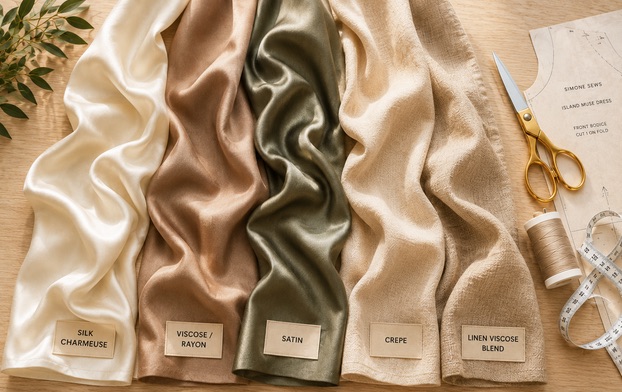
Understanding Why Fabric Matters So Much for Cowl Necklines
A cowl neckline is cut on the bias at the neckline edge. That bias cut is what creates the drape: because fabric cut at 45 degrees to the grain has significantly more stretch and flexibility than fabric cut on the straight grain, the neckline edge can fall and fold in a way that straight-grain cut fabric cannot.
For a cowl neckline to work, the fabric must have two specific properties that are sometimes in tension with each other: enough weight to fall under gravity, and enough fluid softness to fold without resistance. Most fabrics fail because they have one without the other.
The Gold Standard: Silk Charmeuse
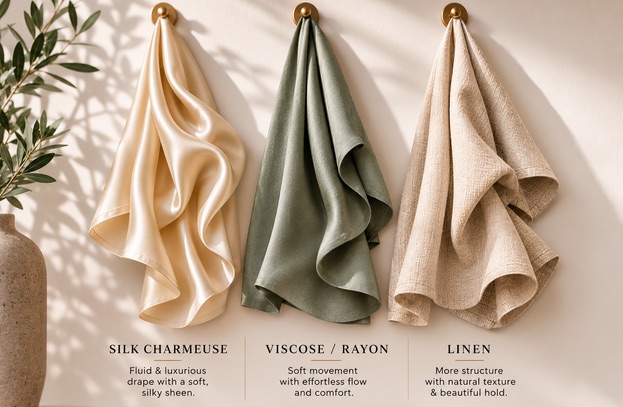
There is no more perfect cowl neckline fabric than silk charmeuse, and I say this having tried everything. It combines a luminous sheen on the face, a matte softness on the back, extraordinary fluid weight, and a bias-cut behaviour that is unlike any other fabric. In silk charmeuse, the Island Muse cowl neckline does exactly what it was designed to do: it falls in deep, continuous folds that move with the body and catch the light.
Working with Silk Charmeuse
Silk charmeuse is not a beginner fabric. It slips under the presser foot. It frays rapidly. It shows every pin hole. It requires a fine needle (size 60/8 or 70/10), a walking foot for straight seams, pins only within seam allowances, and careful pressing with a low-temperature iron over a pressing cloth. Pre-washing in cold water by hand is essential — silk charmeuse can shrink up to 10% in the first wash. Expect to pay $25–$60 per yard for quality silk charmeuse.

The Best Accessible Choice: Viscose / Rayon Challis
For most sewists, viscose rayon challis is the answer. It produces excellent cowl neckline results at a fraction of silk's cost, is widely available in an extraordinary range of prints and colours, and is much more forgiving to sew than silk charmeuse. Viscose challis has a beautiful matte drape — not as luminous as charmeuse, but soft and fluid in a way that reads as genuinely elegant.
What to Look For in Viscose
Not all viscose behaves the same way. Challis (a plain or twill weave with a slightly napped finish) is the best option for cowl necklines. Weight matters: look for viscose in the 3–4 oz per yard range. Too light and you lose the drape weight; too heavy and the fabric starts to hang rather than fold.
Pre-Washing Viscose
Always pre-wash viscose before cutting. Rayon can shrink significantly — up to 8% — in the first wash. Pre-wash in cool water on a gentle cycle, remove promptly, and dry flat or hang. Press while slightly damp for the smoothest result.
Crepe de Chine: The Sophisticated Alternative
Crepe de chine — available in both silk and polyester versions — is another excellent choice. Its characteristic pebbly texture gives it a subtle visual interest while its fluid drape makes it handle beautifully on the bias cut. Crepe de chine has a slightly different silhouette than charmeuse or challis — the folds are slightly more defined, the drape slightly more controlled. For a more structured, architectural cowl neckline, this can be an advantage.
Georgette: For a Floatier, More Romantic Result
Georgette is a crinkle-weave fabric with a characteristic floaty drape. It is lighter than crepe de chine and produces a different quality of cowl — more romantic and flowing, less structured. Double-layer georgette is a particularly good choice for the Island Muse: the double layer adds just enough weight to make the cowl fall properly, while the floaty quality creates movement as the wearer walks that is genuinely beautiful.
Be aware that georgette frays aggressively. Finish all raw edges immediately after cutting — either with a serger, a zigzag stitch, or Hong Kong seam allowances.
What Absolutely Does Not Work (And Why)
Quilting Cotton and Cotton Lawn
Cotton quilting fabric is stiff. Cotton lawn is slightly softer, but still too crisp for the bias cut to do its job. In both, the cowl neckline stands rather than falls. Avoid both entirely for cowl neckline designs.
Linen
Even medium-weight linen is too structured for a cowl neckline. Linen's natural crispness means the bias cut cannot create the necessary fold and drape. The finished cowl looks like it is trying to stand up, which is exactly the wrong effect.
Jersey and Knit Fabrics
The Island Muse Midi Dress is designed for woven fabrics. Jersey will not behave as the pattern instructs — the seam allowances will stretch, the construction sequence will not work as written, and the final silhouette will be completely different from the pattern's intended design.
How to Test Fabric Before You Buy
Here is the test I use at the fabric store. Take about half a meter of the bolt and drape it over your hand with the bias grain vertical — roughly diagonal to the selvedge. Let it fall. If it falls in soft, continuous folds with no resistance, it will likely work. If it resists, springs back, or collapses into stiffness at any point, it will not. Trust this test. It takes thirty seconds and it saves hours of frustration.
Where to Buy the Right Fabrics
Finding the right fabric doesn't have to mean spending a fortune. Whether you're shopping in Canada or the United States, there are plenty of excellent sources for beautiful fabrics with the soft drape a cowl neckline deserves.
In Canada
Fabric Fabric (Toronto) — One of Canada's largest garment fabric stores, Fabric Fabric offers an extensive selection of rayon, viscose, silk charmeuse, crepe, satin, linen blends, and designer deadstock. Whether you're looking for an everyday fabric or something luxurious for a special occasion, it's a fantastic place to start.
Affordable Textiles (Toronto) — A favourite among Toronto sewists, Affordable Textiles carries an excellent range of fashion fabrics, including rayon, silk charmeuse, linen, and crepe, with new arrivals added regularly. It's a great destination for finding quality fabrics at accessible prices.
Designer Fabrics (Toronto) — If you're looking for premium European fabrics, luxury silks, and beautiful designer textiles, Designer Fabrics is well worth a visit. Their carefully curated selection is ideal for creating elevated garments that will last for years.
GK Fashion Fabrics (Toronto) — Another hidden gem in Toronto's garment district, GK Fashion Fabrics is known for its wide selection of fashion-forward fabrics, including designer deadstock, linen blends, rayon, crepes, satins, and suiting fabrics. It's a favourite stop for many local garment sewists looking for unique finds.
Blackbird Fabrics (British Columbia) — One of Canada's most respected online fabric shops, Blackbird Fabrics offers a beautifully curated collection of premium garment fabrics, making it easy to shop high-quality fabrics from anywhere in the country.
In the United States
Mood Fabrics — Famous for its incredible selection, Mood Fabrics carries everything from silk charmeuse and crepe de chine to rayon challis and luxurious designer fabrics. It's an excellent choice when you're looking for a specific fabric or colour.
Denver Fabrics — A long-time favourite for garment sewists, Denver Fabrics offers quality fashion fabrics with a wide variety of fibres, prints, and textures.
Fabric Mart — Known for frequent sales and designer closeouts, Fabric Mart is an excellent place to find rayon challis, crepe, and other dress fabrics at great value.
Raspberry Creek Fabrics — If you're looking for beautiful rayon and viscose prints, Raspberry Creek Fabrics offers a wonderful selection that works especially well for relaxed, everyday versions of the Island Muse Dress.
No matter where you shop, don't overlook the clearance section. Some of my favourite fabrics have been end-of-bolt rayon and viscose finds purchased for a fraction of their original price. A beautiful drape matters far more than an expensive price tag.
Download the free Island Muse Fabric Guide below for recommended fabric weights, yardage requirements, and a printable fabric selection checklist to help you choose the perfect fabric for every size in the pattern range.

Self-taught sewist from Trinidad and Tobago, based in Canada. Creator of original PDF sewing patterns. Follow @simonesews_ on Instagram.
PDF pattern · Sizes 0–20 · A4, Letter and Projector · Instant download
Subscribe